
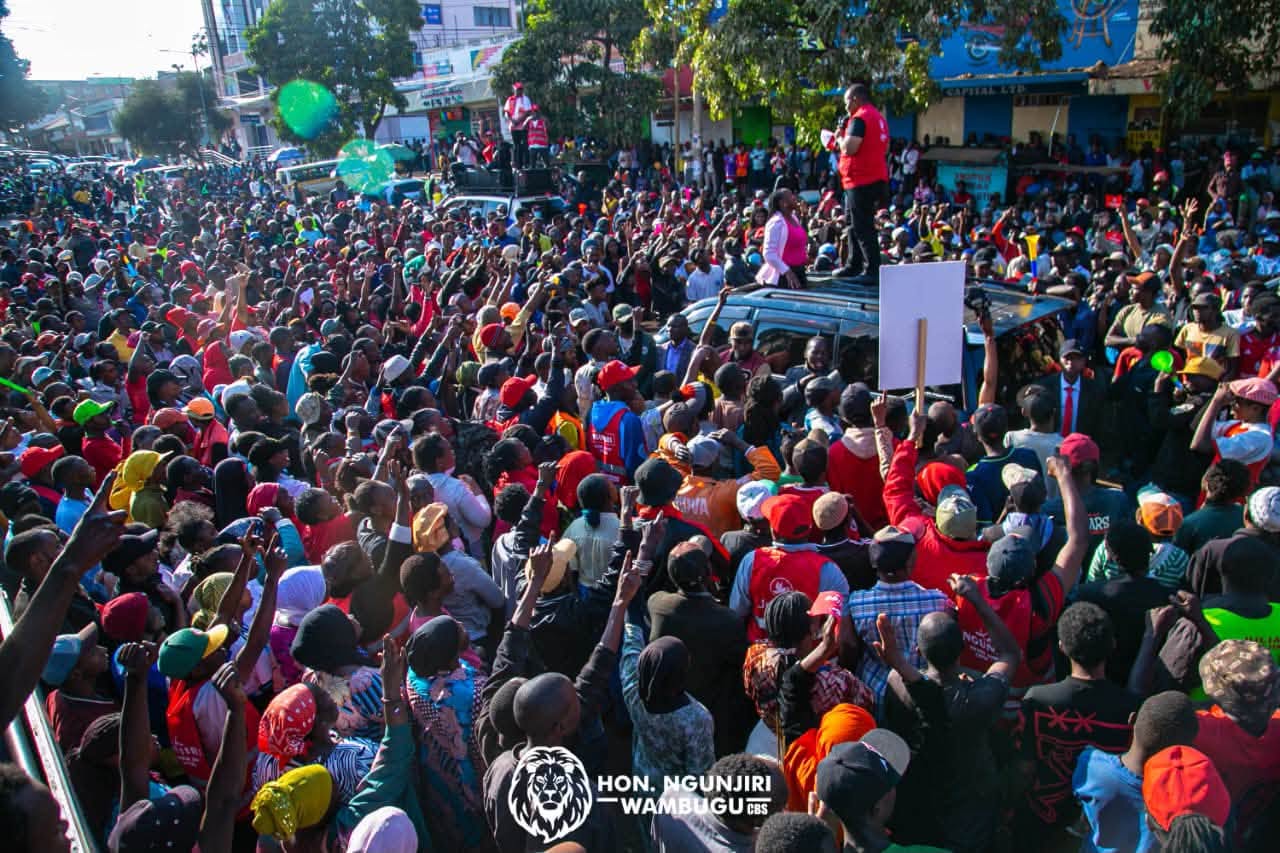
Jubilee Party is building a grassroots political network in Mt Kenya around Njamba cia Ruriri — Heroes of the Community — in what could mark a major departure in how the region organises its politics ahead of the 2027 General Election.
The initiative is emerging as the party’s alternative to the personality-driven mobilisation associated with former Deputy President Rigathi Gachagua and his Itungati cia Gachagua network. Jubilee is seeking to show how Itungati follows an individual, while Njamba stands for the community.
Rather than rallying Mt Kenya behind another single political figure, the party is bringing together aspirants, elected leaders, professionals, businesspeople, farmers, youth and women leaders who already command influence in their respective communities.
The strategy draws from an older political tradition in Mt Kenya, where influence was spread among chiefs, elders, activists and local associations rather than concentrated in one regional political personality. During the colonial period, Senior Chief Waruhiu wa Kung’u and Chief Koinange wa Mbiyu were influential in Kiambu, while Murang’a had Chief Njiiri wa Karanja and Nyeri and the wider Central Kenya region had Paramount Chief Kinyanjui wa Gathirimu.
In 1924, local African leaders established the Kikuyu Central Association, creating an organised platform through which grievances over land, education and political representation could be pursued.
Jomo Kenyatta joined the association and became its general secretary in 1928, later helping establish Muigwithania. Leaders including Joseph Kang’ethe, James Beautah, Kenyatta, Job Muchuchu and Jesse Kariuki were part of the broader political agitation against colonial policies, particularly the seizure of fertile African land. The politics of the period was therefore built around association and collective action rather than one regional political kingpin.
Independence altered that political architecture. Kenyatta’s elevation to the presidency made him the dominant political reference point for Mt Kenya, combining national authority with overwhelming regional influence. When Mwai Kibaki became President, he inherited much of that political mantle, followed by Uhuru Kenyatta.
For decades, the region’s political fortunes were consequently associated with a succession of powerful personalities who could speak to both State House and the political base in Central Kenya. With the Kenyatta era now behind it, however, Mt Kenya is confronting a different political question on whether to once again organise itself around one dominant figure or build a more dispersed network of local leaders.
Jubilee appears to be betting on the latter. Under Njamba cia Ruriri, the party wants political aspirants to become the building blocks of a wider regional movement rather than mere candidates awaiting party tickets.
Each leader is expected to cultivate influence in a ward, constituency or county, build relationships with residents and develop a political base rooted in local issues. Jubilee would then connect these separate centres of influence into a broader regional and national network.
The first signs of the strategy are emerging through Jubilee’s mobilisation of its growing network of aspirants.
On Sunday, Deputy Party Leader Jeremiah Kioni kicked off mobilisation activities when he was hosted in Kipipiri Constituency by parliamentary aspirant Dan Mbui alongside his entourage. Such engagements are increasingly becoming important points of contact between the party leadership and local political actors as Jubilee seeks to strengthen its grassroots presence ahead of 2027. The aspirants could form the first generation of Njamba cia Ruriri — 2027, provided they can translate their local standing into sustained community organisation and political influence.
The initiative places Jubilee on a different path from the political identity being cultivated around Gachagua. DCP has increasingly organised its Mt Kenya mobilisation around the former Deputy President, with Itungati cia Gachagua providing an organisational vehicle for that personality-centred politics.
Jubilee is deliberately avoiding creating its own version of Itungati around another individual. Its proposition is that Mt Kenya does not need to exchange one political father figure for another, but should instead produce a generation of leaders capable of commanding respect and articulating community interests while operating within a larger collective movement.
For that proposition to hold, however, Njamba ya Ruriri cannot simply become another name for a Jubilee supporter. The distinction must be earned through community service, credibility, courage, organisation and the ability to mobilise people around genuine local concerns. If Jubilee succeeds in building a network whose legitimacy comes from communities rather than the party headquarters, it could establish a political structure in which influence is distributed across hundreds of local actors instead of concentrated in one regional figure.
The emerging contest is therefore bigger than Jubilee versus DCP, or Kioni versus Gachagua, but one over the political architecture of Mt Kenya after the era of Kenyatta, Kibaki and Uhuru.
Njamba cia Ruriri is not being presented as an anti-Gachagua movement, but as an argument against the assumption that Mt Kenya must always have one political figurehead.
From the collective politics of the KCA nearly a century ago to the proposed network of local Njamba today, the region could be circling back to an old idea where political power can be organised through many leaders with different centres of influence, united by shared community interests.