
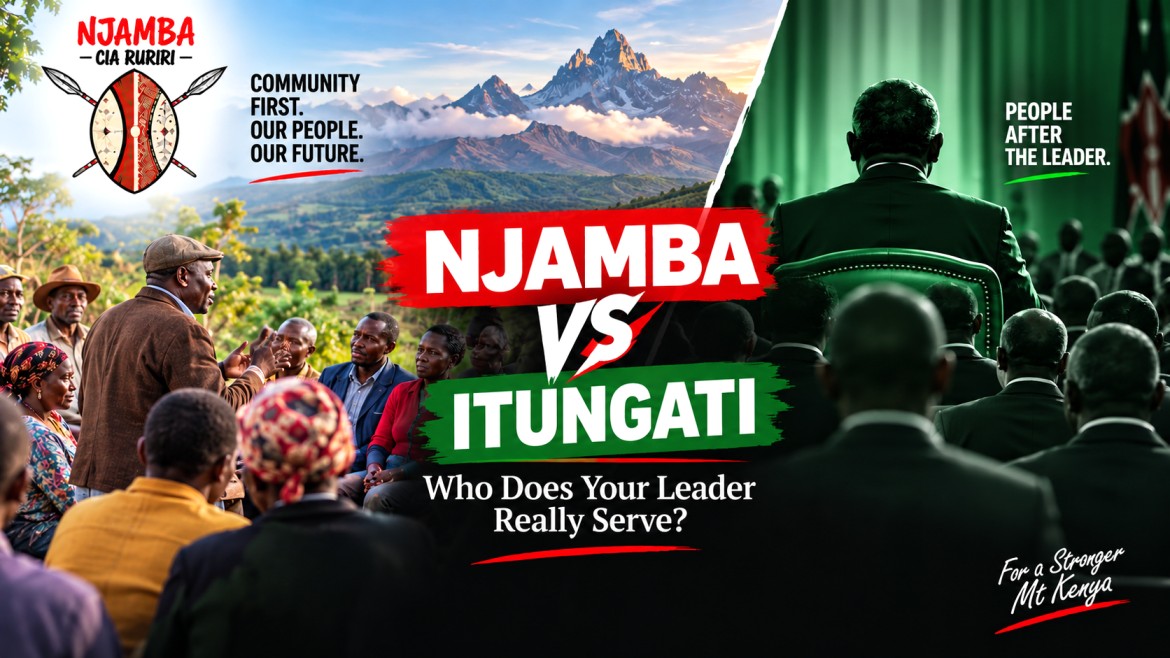
The central argument behind Njamba Cia Ruriri is not that Mt Kenya needs a better political personality. It is that the region needs a different way of organising political authority — one in which the community, rather than an individual leader, sits at the centre of the arrangement.
The Njamba proposition begins with a simple reversal of the traditional political chain. Instead of a leader determining the position that local politicians carry to their people, the people determine the interests that their leaders carry into the political arena.
That distinction matters because political power is rarely neutral. When authority is concentrated around one individual, politicians operating below that centre can become more interested in preserving their relationship with the powerful figure than defending an inconvenient position demanded by their constituents.
Njamba is built around the opposite principle: a leader derives his authority from the community.
That gives the local politician room to negotiate, disagree and bargain without treating every departure from the political centre as an act of disloyalty.
In practical terms, it means a farmer’s concerns can remain a farmer’s concerns even when they conflict with the interests of a national coalition. A trader’s position does not have to change because a political heavyweight has changed his own. A constituency leader can enter negotiations carrying a mandate from the people rather than instructions from above.
This is where the Njamba model differs most sharply from leader-centred politics.
The Njamba asks: “What do our people need?”
The political system it challenges asks first: “What does the leader want?”
The first question produces representation. The second can produce political obedience.
Njamba’s case also rests on the idea that Mt Kenya does not require a single political command post to negotiate its interests. The region has enough political, professional, business and community talent to sustain a wider network of leaders who can cooperate without becoming political dependants of one person.
That distributed leadership has an important advantage: political failure becomes harder to concentrate in one individual.
If one leader disappoints, the entire community does not have to wait for another saviour. Other leaders can step forward, organise, negotiate and carry the argument forward.
That is the logic behind the Njamba proposition that Mt Kenya needs many strong community leaders rather than one political kingpin.
But the argument goes beyond political independence.
Njamba links leadership to Utonga — prosperity. Politics, in this view, is not successful because a politician has secured a powerful office or negotiated a prestigious appointment. Its measure is what reaches the household: functioning markets, better opportunities for young people, stronger businesses, productive agriculture, infrastructure and improved economic prospects.
Then there is Wendani — unity.
A community that allows political competition to turn neighbours into enemies eventually pays for its politics socially. Njamba therefore treats political disagreement as compatible with community solidarity. People can belong to different parties, support different candidates and still share an interest in the welfare of the same community.
At the centre of it all is Wiathi — freedom: the freedom of local leaders to speak without waiting for political permission and the freedom of communities to demand representation rather than allegiance.
That is the strongest case for the Njamba model.
It does not promise that every Njamba will be competent. It does not eliminate political competition. It does not guarantee that every local leader will put community interests first.
What it changes is where the political contract begins.
The community gives the leader authority. The leader carries the community’s interests into the arena. And political power becomes a means of serving the people rather than the reason the people are expected to serve political power. That is the fundamental Njamba proposition, not a new kingpin for Mt Kenya, but a political culture in which the community no longer needs one.